February 2021

Five women were allegedly kidnapped in Afrin in February 2021. None were reported to have been released. Armed actors reported to be responsible for kidnappings of women in Afrin this month include the Military Police, the Civil Police, and Turkish security personnel.

On February 5th, Khalida Khalil was kidnapped from Afrin city by the Military Police and Turkish personnel, according to the Violations Documentation Center in Northeast Syria.

On February 15th, Havin Bakr Musa was kidnapped from Afrin city center by the Military and Civil Police while trying to travel to another village, along with her infant child. According to multiple sources, she has two other children, and her husband is disabled.

On February 23rd, three women— Suzan Battal Khader, Helin Battal Khader, and Amina Mustafa Qasim—were among many civilians detained in raids in the village of Basuta, after an explosion in a house killed two Afrin residents.

According to the Human Rights Organization – Afrin, Helin Battal Khader was the wife of one of the victims of the explosion. Suzan Battal Khader is the sister of Helin Battal Khader. Amina Mustafa Qasim is the mother of the other victim of the explosion.

The armed group responsible was not specified in any reports.
January 2021

Three women and one girl were reported to have been kidnapped during the month of January. One was reportedly released, while the whereabouts of three remain unknown. Armed groups known to be responsible for kidnappings this month are Ahrar al Sharqiyah and Sultan Suleiman Shah.

On January 6th, Roshin Amouna Mohammed was kidnapped by an unknown armed group, according to a local source who spoke with the Missing Afrin Women Project. This was the second time that she had been abducted.

Roshin had recently been released after more than two years in custody. She was kidnapped for the first time in September 2018, from the village of Dar Kabir near Mobata.

In June 2020, she was identified as one of at least eight women in an illegal prison run by the Hamza Division.

She was released, along with three family members who had been kidnapped at the same time, on December 21st, 2020.

Information from the Afrin Canton Independent High Electoral Commission from 2015 suggests that she had been elected to the municipal council in Mobata when Afrin was controlled by the Autonomous Administration of North and East Syria. This suggests that she may have been targeted for political reasons.

On January 19, a 16-year-old girl named Amal Fathi Rashid was reportedly abducted by Sultan Suleiman Shah from the village of Hec Bila, near Sheikh al-Hadid.

The Syrian Observatory for Human Rights corroborated the report. Sultan Suleiman Shah is known to control the area around Sheikh al-Hadid.

On January 23rd, Khaleda Hussein was reportedly kidnapped from a village near Jinderes by members of Ahrar al Sharqiyah. Multiple reports state that she is disabled.

The Afrin Activists Network alleges that two members of Ahrar al Sharqiyah, known as Hamad Jassim and Abu al-Aynaa, were the perpetrators. They also claim that she was being held at a house belonging to one of the leaders of the group.

On January 27th, she was released. The Human Rights Organization in Afrin claims that this was due in part to the widespread publicity the case received, which they claim forced authorities to act.

In late January, a woman named Berivan Shahin was reportedly kidnapped while traveling from Kafr Safreh to Jinderes by an unknown armed group. According to the Afrin Activists Network, she was taken to a prison in Kafr Janneh and then transferred to Idlib Governorate.

2020 Report

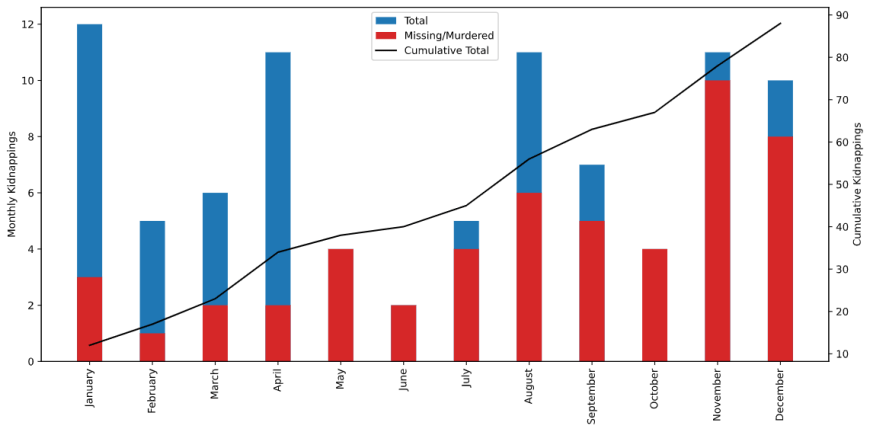
88 women and girls whose identities are known were reportedly kidnapped by Turkish-backed armed groups in Afrin, Syria in 2020, a rate of approximately one incident every four days.

As of January 1, 2021, 51 remained missing. 35 were reported to have been released. One had allegedly been murdered.

17 of the 35 individuals who have been released were reportedly freed after the payment of a ransom. Ransoms were paid in US dollars, Syrian pounds, or Turkish lira.

The months with the highest number of incidents were January, April, August and November, with 11 cases each; followed by December, with 10 cases. 

Armed Groups Implicated

The Syrian National Army (SNA) factions implicated in kidnappings in 2020 were Ahrar al Sham, Ahrar al Sharqiyah, Failaq al Sham, Hamza Division, Jabhat al Shamiyah, Jaish al Islam, Jaish al Nukhba, Jaish al Sharqiyah, Liwa al Waqqas, Liwa Samarkand, Liwa Sultan Mehmed Fatih, and Sultan Murad Division.

The Military Police and Civil Police, which are security forces made up of armed group members but directly organized by Turkey, were implicated as well, along with Turkish security forces themselves.

Some incidents involved more than one armed group.

The three SNA factions responsible for the most reported incidents—Ahrar al Sharqiyah, the Hamza Division, and the Sultan Murad Division—have all been implicated in reports of torture or sexual and gender-based violence since taking control of Afrin in 2018.

Of the SNA factions that were implicated in kidnappings this year, six— the Sultan Murad Division, the Hamza Division, Failaq al Sham, Jabhat al Shamiyah, Failaq al Sham, Jaish al Islam, and Jaish al Nukhba—had received some form of US support at some point in their history.

Abductions of Minors

Six minor girls were abducted in Afrin in 2020. Five of them remained missing as of January 1, 2021, while one had been released. Jaish al Nukhba, the Hamza Division, the Sultan Murad Division, Ahrar al Sharqiyah, and the Military Police kidnapped girls in 2021.

Allegations of Torture

14 cases, or about 15% of the incidents, included direct allegations of torture. Three of these individuals remained missing as of January 1, 2021, while 11 had been released. The Hamza Division, Failaq al Sham, Jabhat al Shamiyah, Jaish al Nukhba, Political Security, and the Military Police were all implicated in allegations of torture in 2021.

Allegations of Sexual Violence

Three cases included direct allegations of sexual violence. Two of these cases involved forced marriages, while the remaining case included an allegation of rape in detention. Two of these individuals remained missing as of January 1, 2021, while one had been released. The Hamza Division and the Sultan Murad Division were implicated in allegations of sexual violence in 2021.

Religious Minorities

Seven cases targeted women specifically identified as members of religious minority communities. Five Yezidi women and two Alevi women were reportedly abducted.Several of these kidnappings took place during broader raids by armed groups on certain villages historically home to religious minorities.

Five of the seven individuals were reportedly tortured in custody— a higher rate of allegations of torture than seen in general.

Interactive Map

Click below to view an interactive map with detailed information and sources on all reported 2020 incidents.

December 2020

Eight women and two girls were allegedly kidnapped in occupied Afrin in the month of December. Seven of these individuals remain missing, two were reported to have been released, and one has reportedly been murdered. Three were reported to belong to religious minority communities. Armed groups implicated in kidnappings this month were Ahrar al Sharqiyah, Failaq al Sham, the Hamza Division, Jabhat al Shamiyah, and the Sultan Murad Division.

Ghazala Manan Hussein, a Yezidi woman from Basûfanê, was allegedly kidnapped from that village by Failaq al Sham in early December and taken to a prison in the village of Iska. The date of her abduction is unknown.

The Human Rights Organization in Afrin alleged that she and other Yezidi detainees from the village were tortured in custody.

On December 28th, the Human Rights Organization – Afrin noted that other Yezidi detainees had been released, but that her fate remained unknown.

In early December, Fatima Mahmoud Hunik and her thirteen-year-old daughter Alia Adnan Jammo were reportedly kidnapped from their home in Afrin’s Mahmudiyah neighborhood by the Hamza Division in a raid targeting their entire family, according to the Afrin Post. The family was subsequently handed over to the Military Police. The date of their abduction is unknown.

On December 3rd, Nadira Darmash was reportedly abducted from her home in Afrin city’s Old Afrin neighborhood by the Sultan Murad Division. According to the Afrin Post, she was subsequently murdered, and her body was left in the area. According to both the Afrin Post account and a separate allegation made by the Human Rights Organization in Afrin, militia members also stole valuables from her property, including a computer, a phone, cash, and multiple cars.

On December 6th, two women, Khaleda Sheikh Murad and Amina Abdo Murad, were kidnapped from the town of Jinderes by Ahrar al Sharqiyah.

According to local monitor Ezdina, the women were targeted on the basis of membership in a civilian neighborhood assembly under the Autonomous Administration.

On December 19th, two women, Hevin Hambasho and Rahila Mukhtar, were kidnapped from the town of Mobata by Jabhat al Shamiyah, during a raid that targeted large numbers of civilians around the village. The Afrin Civil Society Assembly first reported the raid and the names of the detainees on December 22nd.

According to the Human Rights Organization – Afrin, the victims belonged to the region’s Alevi religious minority.

On December 29th, the Human Rights Organization – Afrin reported that the two women and several other detainees had been released after about four days in custody, and claimed that they had been subjected to torture.

On December 21st, a sixteen-year-old girl, Fatima Mohammed Raskelah, was reportedly kidnapped by Ahrar al Sharqiyah.

On December 29th, Laila Mahmoud Jafar was reportedly kidnapped from the village of Mirkan by Jabhat al Shamiyah. According to the Afrin Media Network, her husband and teenage son had also been kidnapped by the group.

The Human Rights Organization – Afrin corroborated the disappearance of her husband, noting that he owned a shop in the village.

November 2020

11 women were reported to have been kidnapped in occupied Afrin in November. One has allegedly been released, while 10 others remain missing. Armed groups claimed to be responsible for kidnappings during this month included the Military Police, Ahrar al Sharqiyah, and Ahrar al Sham.

On November 2nd, Berivan Hiso was reportedly kidnapped from the village of Çobana by the Military Police, along with her husband. She was released the same day.

At least one source alleged that the family was targeted so that armed groups could seize their olive groves.

On November 23rd, four women were allegedly kidnapped from Baflorê village in Jinderes: Aisha Hassou Hamid, Farida Hammu Hussein, Amina Hamid Hanan, and Shafiqa Mohammed.

The Afrin Activists Network claimed that the Military Police were responsible for the kidnapping, while the Human Rights Organization – Afrin said that Ahrar al Sharqiyah was responsible.

According to the Human Rights Organization – Afrin, the four women have been accused of dealing with the AANES and are being held in Jinderes on a ransom of 2,000 Turkish lira each.

Also on November 23rd, Gula Nouri Rashid, Moulida Mohammed Jabo, Halima Musa Jouleh, and Asya Mohammed Jarro were kidnapped from Rajo district by Ahrar al Sham. Gula Nouri Rashid and Halima Musa Jouleh had both allegedly been kidnapped in 2018 and subsequently released on ransom.

On November 26th, Nourhamin Kilo and Josephine Sheikho Hamid were kidnapped from Anqele village in Sheikh al-Hadid district by the Military Police.

While a male relative kidnapped at the same time may have been released on ransom, according to the Human Rights Organization – Afrin, the two women are thought to have been transferred to Turkey.

International Day of the Girl: girls in Afrin not spared violence

Background

In 2011, the United Nations declared October 11 as the International Day of the Girl Child, calling on member states to uphold the protections for girls included in the Convention on the Rights of the Child and the Convention on the Elimination of All Forms of Discrimination against Women.

In 2020, the U.N. has chosen to observe this day by highlighting the provisions protecting girls’ rights in the Beijing Declaration and Platform for Action, which was adopted 20 years ago. It has specifically called on the international community to take action to protect girls from gender-based violence and harmful practices, including forced marriages and underage marriages.

17 girls whose names are known have been reported to have been kidnapped in occupied Afrin since 2018. Seven have reportedly been released, while the whereabouts of 10 others are unknown. Four were reportedly subjected to some form of torture or sexual violence in custody, including two alleged instances of forced marriages. Syrian National Army groups allegedly implicated in the kidnapping of minor girls include the Hamza Division, the Sultan Murad Division, Ahrar al Sharqiya, Jaysh al Nukhba, Jabhat al Shamiyah, Failaq al Sham, and the Turkish-backed Military Police.

The most recent report from the U.N. Commission of Inquiry on Syria stated that “women and girls have been detained by Syrian National Army fighters, and subjected to rape and sexual violence – causing severe physical and psychological harm at the individual level, as well as at the community level.” Reports from human rights monitors also suggest that rates of underage marriages are increasing in Afrin, due to both violence from armed groups and a lack of legal protections.

10 Girls Still Missing

The 10 reported cases of missing girls in Afrin seen by the Missing Afrin Women Project include incidents that took place as early as January 2018 and as recently as September 2020.

Aya Nuri Rasho, 13 at the date of the incident, and Nura Nuri Rasho, 11 at the date of the incident, were allegedly kidnapped along with several relatives by an unidentified armed group in Bulbul in January 2018.

Asia Shabaan Ibrahim, 16 at the date of the incident, was allegedly abducted along with her brother in March 2018 from the village of Hesen Dera by an unidentified armed group. Some reports indicate that her brother was killed in custody, while others allege that he remains missing as well.

Yasemin Hesen, 12 at the date of the incident, was allegedly abducted from Darmashkanlī village in May 2018 by an unknown armed group and forced to marry one of its members.

Rojin Mohammed, 17 at the date of the incident, was allegedly kidnapped by the Sultan Murad Division or the Hamza Division in July 2018, following the kidnapping of her sister Lonjin Mohammed and her father Mohammed Khalil Abdo.

On June 15th, 2020, Afrin Post identified Rojin as one of the women detained in an illegal prison run by the Hamza Division in Afrin city. A member of the family told Rudaw on June 17th that the sisters were likely now held in a Hamza Division base in Bassouta.

Jihan Tana, 17 at the date of the incident, was allegedly abducted from Jinderes in August 2018 by members of Nour al-Din al-Zenki Movement, along with several relatives.

Lafa Mustafa Yousef, 17 at the date of the incident, was allegedly abducted from her family’s home in the Mahmoudiyah neighborhood of Afrin city by members of an unknown armed group in November 2018. The group reportedly stole 350,000 SYP from the home.

Shatha Khalil Mustafa, underage at the date of the incident, was allegedly abducted from Ba‘dinlī village near Rajo by the Military Police in March 2020.

Melek Nabih Khalil Juma, 16 at the date of the incident, was allegedly abducted by the Sultan Murad Division in May 2020 after refusing marriage proposals from a member of the group.

Some sources initially claimed that she was murdered, though others later identified the body found near Azaz and claimed to be hers as a different woman who had been killed by a male relative. In an interview published by Hawar News, a relative stated that her family did not know where she was or if she was alive or not.

Maryam Afdik Sheikho, 17 at the date of the incident, was allegedly kidnapped by Ahrar al Sharqiyah in September 2020. She was accused of dealing with the Autonomous Administration of North and East Syria.

Rates of Underage Marriage Increasing

Kidnappings, forced marriages, and other threats posed by armed groups have also led to a reported increase in underage marriages in occupied Afrin, according to a report published by the Violations Documentation Center in Northeast Syria.

Some families have reportedly forced their underage daughters to marry relatives in order to “protect” them from armed groups. A video obtained by the Missing Afrin Women Project shows one alleged incidence of a man beating his wife after she had refused to allow a member of an armed group to marry their daughter.

Underage marriage and forced marriage were both outlawed by the Autonomous Administration of North and East Syria when it controlled Afrin. Civil society organizations worked to stop these practices when they took place and raise awareness of their harmful effects. Similar efforts have not been made by Turkish-backed authorities.

Recommendations

The United Nations Commission of Inquiry on Syria has found that, in areas of Syria under Turkey’s effective control, Turkey “remains bound by applicable human rights treaty obligations vis-à-vis all individuals present in such territories.”

U.N. High Commissioner for Human Rights Michele Bachelet has called on Turkey to “immediately launch an impartial, transparent and independent investigation into the incidents we have verified, account for the fate of those detained and abducted by the affiliated armed groups and hold accountable those responsible for what may, in some instances, amount to crimes under international law, including war crimes.”

Turkey has adopted the Beijing Declaration and Platform for Action, the Convention on the Rights of the Child, and the Convention on the Elimination of All Forms of Discrimination Against Women. By allowing abductions and disappearances of girls and sexual and gender-based violence against girls to take place in Afrin, and overseeing an environment of violence and gender discrimination there that has “in effect confined [women and girls] to their homes,” Turkey is in violation of these commitments.

The international community must hold Turkey and the SNA fully accountable for all violations of girls’ rights in Afrin and other occupied regions of Syria, and demand an end to all forms of sexual and gender-based violence and gender discrimination in these areas.

September 2020: Seven women reported kidnapped, one released

Seven women were reported to have been kidnapped by armed groups in occupied Afrin in September. Only one has allegedly been released.

On September 6th, two women, Tolin Rashid and Medya Khanjar, were kidnapped by the Military Police and Turkish personnel. Both were allegedly affiliated with the local government in Mobata district. One source claimed that Khanjar is the daughter of Ibrahim Khanjar, whom they identified as a member of the local council.

Khanjar was reportedly released on or before September 13th. According to the Human Rights Organization – Afrin, a ransom of 600 to 1,000 Turkish lira was set for each of the detainees kidnapped in the operation.

On September 9th, Fatima Qara Mustafa was reportedly kidnapped from Jinderes, in a raid that also targeted the head of the Turkish-backed local council and other local government employees.

Earlier that day, a message posted by the Free Syria News Network, a pro-rebel Telegram channel, identified Qara Mustafa as the wife of Essam al-Bakr, who was also identified as one of the individuals kidnapped in the raid. The channel stated that Qara Mustafa had not yet been arrested, but accused her of espionage and called for her to be targeted.

On September 10th, Khadija Sari bint Abu Abdo was reportedly kidnapped from Jinderes by the Military Police. She was accused of dealing with the AANES, and reportedly worked at a privately-owned pharmacy.

Also on September 10th, a girl named Maryam Afdik Sheikho, born in 2003, was reportedly kidnapped by members of Ahrar al Sharqiyah. She was accused of dealing with the Autonomous Administration.

On September 19th, a 55-year-old woman named Aufa Sido was reportedly kidnapped by an unknown armed group while traveling from her home in Mahmudiyah neighborhood in Afrin city to visit relatives.

On September 23rd, a woman identified only as Zainab, the wife of Khalil Attar, was was reportedly kidnapped from Ashrafiyah neighborhood in Afrin city by members of Jabhat al Shamiyah. The group allegedly stole $2,500 from their home.

August 2020: 11 women reported kidnapped

11 women were reported to have been kidnapped by armed groups in occupied Afrin in the month of August, the highest number of cases reported in any month this year. Five have allegedly been released, while the whereabouts of six are unknown.

Four of the women kidnapped this month were allegedly tortured in custody, and an earlier allegation of torture has been newly documented. Two women were reportedly murdered by their husbands.

Kidnappings

On August 4th, a woman named Dalal Mustafa was reportedly kidnapped by an unknown armed group at an SNA checkpoint in Dêrbelûtê/Deir Ballout, along with members of her brother’s family, according to the Violations Documentation Center in Northeast Syria. A checkpoint is known to exist in the town, which borders HTS-controlled Idlib.

On August 8th, a 60-year-old woman named Fikret, the wife of Mohamed Alou Brimo, was reportedly kidnapped along with her husband and another elderly man, according to the Afrin Activists Network.

On August 15th, three women were allegedly kidnapped from the village of Hêçikê by Liwa al Waqqas: Malak Sobhi Jalabi, Zahida Khalil Sheikh Mustafa, and Maqbola Abdo Tana.

Earlier this month, three men from the same village were also reported kidnapped by Liwa al Waqqas. The armed group was reportedly responsible for killing Fatima Kanna, an elderly relative of the three men.

When Kanna was murdered, several members of her family were reportedly kidnapped and subsequently released—including a woman named Maqbola, identified at the time as the wife of Muhammad Sabri Tana. This could be the same individual as was reported kidnapped in the August 15th incident.

On either August 18th or August 19th, a girl named Salwa Ahmed was reportedly kidnapped by Jaish al Nukhba. Different reports of the incident made different claims about her age, but all sources reported that she is a minor.

The first report of the incident was published on August 20th by the Human Rights Organization in Afrin, which claimed that Ahmed was kidnapped on by an unidentified armed group on August 18th between Maabatli and Afrin, and taken to the village of Emara. They allege that she was released by August 20th, and that militia members involved in the incident had been arrested by the Military Police.

On August 22nd, Afrin Activists Network posted an alleged photo of Ahmed, and claimed that the armed group responsible for the incident was Jaish al Nukhba. They specifically implicated a member of the group named Khaled Zuhair. Their report also noted that there had been unusual security activity and conflicts between different elements of Turkish-backed forces in the area around Emara.

That same day, Afrin Post reported on the incident. They made a similar claim to the account published by the Human Rights Organization in Afrin, alleging that members of Jaish al Nukhba had been arrested and that Ahmed had been released after one or two days. They also alleged, however, that she had been kidnapped so that the group could send her to Libya. No other sources made this allegation.

On August 29th, the Human Rights Organization – Afrin claimed that Ahmed had been kidnapped because Zuhair intended to force her to marry him. They alleged that the Military Police found several dead bodies and large quantities of stolen money when they raided the village, which was controlled by Jaish al Nukhba.

While they claimed that Zuhair was among the members of Jaish al Nukhba who were arrested in the aftermath of the incident, the Violations Documentation Center in Northeast Syria claims that he has fled Syria to Turkey.

On August 20th, Farida Abdo was reportedly kidnapped from Çolaqa village by the Military Police, along with other civilians. According to the Human Rights Organization – Afrin, she was subsequently released on a ransom of 850 Turkish lira.

On August 24th, 2020, four women were reportedly kidnapped by the Military Police from the town of Kerzayhel, south of Afrin city: Yasmine Abdo, Siham Saeed Jafar, Khalida Kamal Jaafo and Mawlida Mustafa Jaafo.

Siham Saeed Jafar, Khalida Kamal Jaafo and Mawlida Mustafa Jaafo were reportedly released on ransom after one day, while Yasmine Abdo remains missing.

Allegations of Torture

According to the Human Rights Organization – Afrin, Yasmine Abdo, Siham Saeed Jafar, Khalida Kamal Jaafo and Mawlida Mustafa Jaafo were tortured after being kidnapped by the Military Police this month.

Azima Manan Rasho, a woman who was allegedly kidnapped earlier in 2020 from the village of Şêx Hûtka by Jaish al Nukhba, was reported to have been released by multiple sources this month. She had been kidnapped at least twice prior to this incident.

Both the Afrin Activists Network and the Human Rights Organization in Afrin alleged that she was tortured in custody. The Human Rights Organization in Afrin alleged that she has suffered from ongoing health issues since being released.

Murders of Women

Two women in Afrin were allegedly murdered by their husbands during the month of August.

On August 8th, claims that the body of an unidentified woman had been found in the Ashrafiyah neighborhood of Afrin city began to circulate.

On August 10th, Afrin Activists Network published images of the woman, identifying her as Istarvan Baker. They alleged that she had been murdered by her husband, identified as Abdulqadir Jamil Qarmaz.

On August 11th, Afrin Activists Network published photos showing the body of a woman that had been found near the village of Deir Sawwan. They identified her as Gule Khalil Farraj, and claimed that she had been murdered by her husband, identified as Sheikh Saleh.

Activist Shero Alo published a photo of a man alleged to be Sheikh Saleh on August 11th.

There has been no report claiming that either perpetrator was prosecuted. Sheikh Saleh has allegedly fled the area. The legal system in Turkish-occupied areas is based on Syrian law, with provisions that are perceived to violate Islamic law removed. Women have few protections from gender-based violence. The Syrian Islamic Council, an Istanbul-based body whose rulings are followed by some SNA groups, has ruled that there are cases wherein it is acceptable for a man to murder his female relatives, claiming that the crime is “an act of jealousy that is consistent with human instinct.”

July 2020: Five women reported kidnapped, violence increasing

Kidnappings

Five women were reported to have been kidnapped by armed groups in occupied Afrin in the month of July. One was allegedly released.

On July 9th, Jaish al Islam announced that they had captured two women in Afrin city, accusing them of terrorism and connections with the Syrian Democratic Forces.

Such false charges are a common pretext for kidnappings and disappearances of both men and women in occupied Afrin, including those with no political affiliation or military background.

On July 14th, the Afrin Post documented the identities of both women: Nisreen Walid and Sevin Ahmed Sadiq Ibo. They reported that both were civilians, and that the mother and siblings of one woman were attacked in their home after the arrests.

Neither has been reported released. Both the Afrin Post report and a later report from the Afrin Activists Network alleged that they were handed over to Turkish authorities.

Malak, the mother of Sevin Ahmed Sadiq Ibo, was reportedly kidnapped on July 10th, according to the July 14th Afrin Post report. She was beaten along with her fifteen-year-old son, and their house in the Ashrafiyah neighborhood of Afrin city was confiscated by the Turkish-backed Civil Police.

On July 13th, members of Sultan Murad Division kidnapped a woman named Rojin, the wife of Jamal Ahmed Khaled, from Babak Ushaghi village, according to the Human Rights Organization – Afrin.

According to the Human Rights Organization – Afrin report, as well as reports from the Violations Documentation Center in Northeast Syria and the Afrin Activists Network, she had been kidnapped before on charges of affiliation with the Autonomous Adminstration of North and East Syria.

A fighter known as Abu Ammar is allegedly responsible for the Sultan Murad Division units in the region.

On July 31st, a woman named Hidayat Tahir Omar, from Bulbul, was kidnapped by members of Sultan Murad Division after a relative living outside of Afrin had transferred a sum of money to her. She was released two days later. Armed groups confiscated the money that had been transferred.

Gender-Based Violence Increasing

A report from the Violations Documentation Center in Northeast Syria noted that there had been an increase in forced marriages and child marriages in occupied Afrin in recent months. Families have forced their daughters to marry relatives to “protect” them from being kidnapped by armed groups, or accepted demands from the groups themselves.

A video that appears to first have been posted on July 22nd by an individual known as Sarok Omar allegedly shows a man from Afrin beating his wife after her refusal to marry their daughter to a member of Sultan Murad Division.

Kongra Star, a coalition of women’s organizations in North and East Syria, shared the video and confirmed the details of the case.

Sultan Murad members have been implicated in many allegations of sexual violence and forced marriages reported from Afrin in recent months, including two cases documented in the Missing Afrin Women project database.

Sexual and gender-based violence, forced marriages, and child marriages were all criminalized in Afrin Canton prior to the Turkish occupation. Women and girls were able to access institutions to protect them from violence and resolve disputes. Today, under the Turkish-backed government, no such legal and civil society protections exist.

Testimonies Describe Torture, Sexual Violence, Threats in SNA Custody

Three video testimonies published this month of women kidnapped or interrogated by SNA factions describe torture, sexual violence, and other cruel and degrading treatment in interrogations and in detention facilities run by the groups.

In June 2020, the Afrin Human Rights Organization reported that a woman who had been working as a hairdresser in Afrin city was accused of witchcraft by Ahrar al Sharqiya. Militia members threatened to rape her during the interrogation, demanded money, and threatened to kidnap her husband.

A video interview with the woman, conducted by the Human Rights Organization – Afrin and shared with the Missing Afrin Women Project, was published by the Rojava Information Center on July 4th, 2020.

On July 29th, Hawar News published an interview with a woman from Afrin who was allegedly kidnapped by the Military Police in June 2019, identified only as E. A. for her safety. Her parents, husband, and three-year-old daughter were all detained with her.

E. A. described being repeatedly beaten and accused of collaborating with the SDF, and claimed that her interrogators threatened to rape her, distribute explicit photos of her, and kill her daughter. She claimed that she knew of many civilians who had died in custody as a result of torture.

She was reportedly released on a ransom of 17 million Syrian pounds, and is now in Shahba region with her daughter.

Hawar News also published an interview with E. A.’s mother, a 50-year-old woman identified as M. A, on July 31st. M. A. was also detained in June 2019, and was in SNA custody for 26 days. She reportedly did not know that other members of her family had been detained, and was shocked to find her daughter and granddaughter in the same prison.

She described being beaten every day and accused of working in a village commune— the smallest political unit under the Autonomous Administration, which worked to settle disputes, distribute goods, and manage other local affairs.

She claimed that women were raped by militia members in prison, and that even children and the elderly were tortured on a daily basis.